Best Email Marketing Software for Small Business in 2026

Email marketing still delivers the highest return of any digital channel. The average ROI sits between $36 and $42 for every $1 spent, according to Litmus.
The problem is choosing the right tool. Pricing has shifted dramatically in 2025 and 2026, and what was the best pick three years ago may not be today.
I tested the four most popular email marketing platforms hands-on. This guide ranks them honestly, names a category winner for each type of business, and points you to the full review when you want the deep dive.
My top picks at a glance
- MailerLite
Best overallBest value
The cheapest serious email platform, with automation included on every paid plan. - Kit (formerly ConvertKit)
Best free planBest for creators
Free up to 10,000 subscribers, with built-in tools to sell digital products. - Mailchimp
Best for beginnersBest templates
The friendliest interface and the most polished template library. - ActiveCampaign
Best automationBest CRM
The most powerful automation builder, with a real CRM built in.
How I tested these tools
Every tool in this guide was tested hands-on. I created accounts, built real welcome sequences, sent test emails, and measured what actually worked.
For each platform I tracked five things: setup time from blank account to first email sent, ease of the drag-and-drop editor, depth of the automation builder, deliverability on a 5-inbox send test, and total cost at 1,000 and 5,000 subscribers.
The full review for each tool links from its section below. Pricing was current as of June 2026 and may have shifted since.
1. MailerLite
MailerLite is the platform I recommend to most small businesses. The paid plans start at $10 a month with unlimited emails included, which is the cheapest serious offer on the market.
Automation comes on every plan, including the free one. The drag-and-drop editor is clean and beginner-friendly.
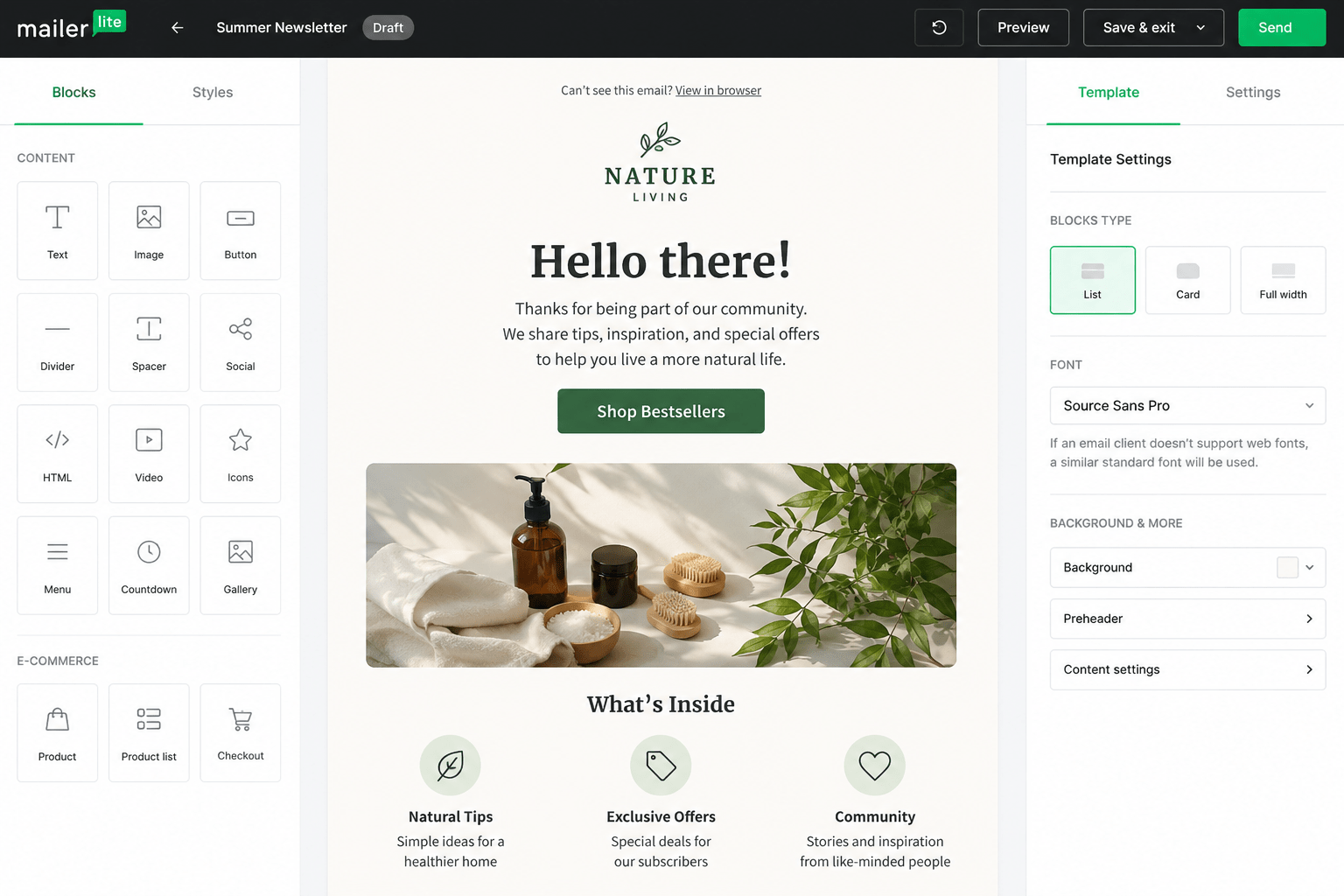
I built a professional-looking welcome newsletter in MailerLite in under 30 minutes. The editor felt intuitive from the first click, and finding advanced settings was the only mild friction.
What you get
Every paid plan includes unlimited monthly emails, full automation, sign-up forms, landing pages, and a basic website builder. The Advanced plan adds custom HTML, AI writing assistance, and more automation triggers.
Free plan covers 500 subscribers and 12,000 sends a month, down from 1,000 subscribers in September 2025. Free emails carry a small MailerLite logo.
Pros
- Cheapest paid plans in the category
- Automation on every plan, including free
- Unlimited emails on all paid plans
- Free landing pages and website builder
Cons
- Free plan halved to 500 subscribers
- Logo on free plan emails
- Transactional emails need a separate product
- Templates less polished than Mailchimp’s
2. Kit (formerly ConvertKit)
Kit is the platform built specifically for creators, newsletter writers, and online educators. It rebranded from ConvertKit in October 2024 but kept the same accounts and features.
The free Newsletter plan covers up to 10,000 subscribers, which is the most generous free tier on the market. Built-in tools let you sell digital products and run paid newsletters from inside the dashboard.
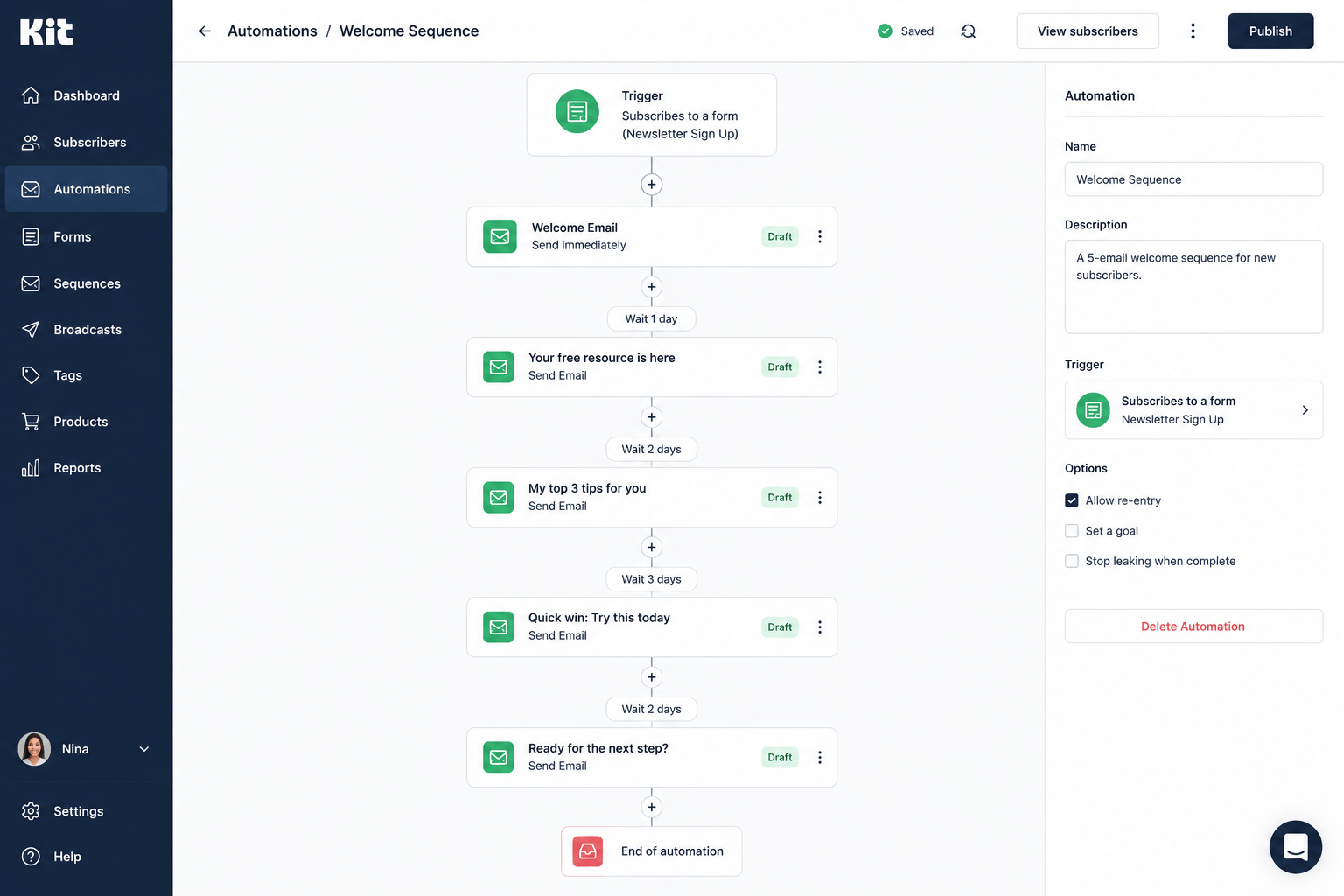
I built a five-email welcome sequence in Kit in under an hour. The visual automation builder made the customer journey easy to map.
The only learning curve was understanding the distinction between broadcasts, sequences, and automations. Once that clicked, the platform was straightforward.
What you get
Subscriber-based pricing with no duplicate billing, since Kit uses a single tag-based list. According to Litmus, automated emails drive 37% of all email sales while making up just 2% of email volume, and Kit’s automation builder makes those flows easy to set up.
Paid plans got pricier in September 2025. Creator starts at $33/month annual ($39/month monthly) for 1,000 subscribers.
Pros
- Free plan covers 10,000 subscribers
- Tag-based, no duplicate contact billing
- Built-in tools to sell digital products
- Strong, transparent deliverability
Cons
- Paid plans rose 35% in September 2025
- Only one automation on the free plan
- Templates are clean but not flashy
- Designed for creators, less ideal for retail
Still not sure which fits you?
Take the 2-minute quiz and get a personalised recommendation based on your list size, budget, and goals.
3. Mailchimp
Mailchimp is the most recognisable name in email marketing and remains one of the easiest tools to start with. The template library is large and professional, and the interface is friendly even to total beginners.
The catch in 2026 is value. The free plan covers just 250 subscribers, and multi-step automation now requires the Standard plan at $20/month.
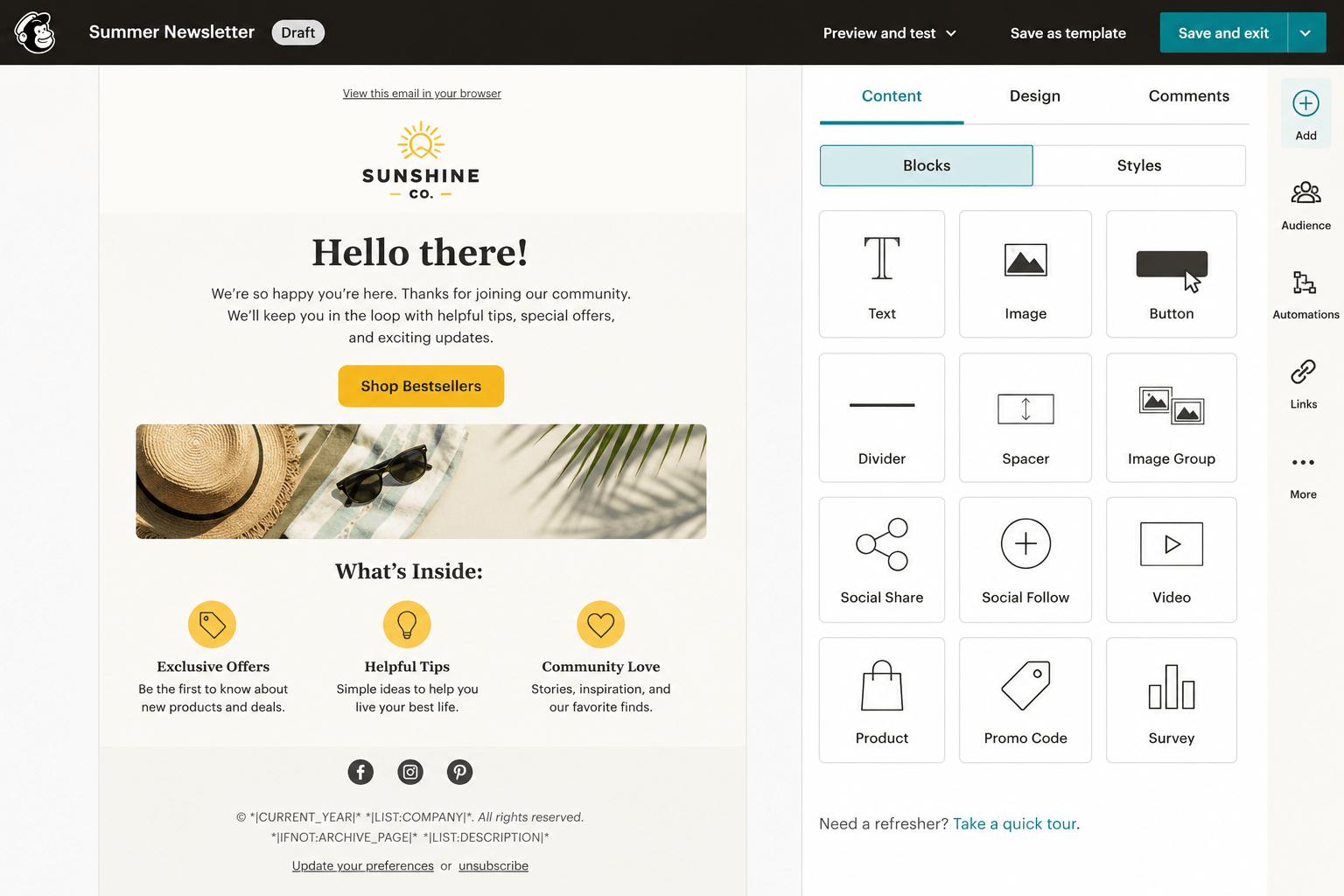
My first Mailchimp campaign took 45 minutes to build. Most blocks snapped into place easily, but customising spacing and mobile formatting required more trial and error than I expected.
What you get
Four plans: Free (250 subscribers), Essentials ($13/month), Standard ($20/month for automation), and Premium ($350/month). The all-in-one platform includes a basic website and landing pages alongside email.
Audience segmentation works well at the basics. Advanced behavioural segmentation is reserved for the higher tiers.
Pros
- Easiest tool to start with
- Largest, most polished template library
- Familiar interface and brand
- Integrates with almost everything
Cons
- Free plan limited to 250 subscribers
- Automation now needs the $20 Standard plan
- Counts inactive contacts toward your limit
- Pricing scales steeply with list size
4. ActiveCampaign
ActiveCampaign is the most powerful tool in this comparison. The visual automation builder, sales CRM, and lead scoring give growing businesses capabilities the other platforms simply do not match.
The trade-off is the learning curve and the price tag. There is no free plan, and the cost climbs steeply as your list grows.

I ran a deliverability test on my welcome series. The email landed in the primary inbox of all five providers tested (Gmail, Outlook, Yahoo, iCloud, AOL) with a 9.6/10 spam check score.
The automation builder is intuitive once you get the hang of it, though list management took some figuring out at first.
What you get
Starter at $15/month, Plus at $49/month, Pro at $79/month, and Enterprise at $145/month (annual billing, 1,000 contacts). Starter caps automations at 5 actions each, so most serious users start at Plus.
The Plus tier and above add the sales CRM, deal pipelines, and lead scoring. That makes ActiveCampaign uniquely powerful for B2B and e-commerce businesses.
Pros
- Best-in-class automation builder
- Real built-in CRM with deal pipelines
- Deep segmentation and personalisation
- Strong deliverability and uptime
Cons
- No free plan, only a 14-day trial
- Real learning curve, not beginner-friendly
- Pricing climbs steeply with list growth
- Add-ons can inflate the bill 30 to 40%
Side-by-side comparison
Quick reference across the four tools, using current 2026 pricing for 1,000 subscribers.
| MailerLite | Kit | Mailchimp | ActiveCampaign | |
|---|---|---|---|---|
| Free plan | 500 subs | 10,000 subs | 250 subs | None |
| Paid from | $10/mo | $33/mo | $13/mo | $15/mo |
| Unlimited sends | Yes | Yes | Plan limits | Plan limits |
| Automation | All plans | 1 on free, all on paid | $20 Standard+ | All plans |
| Built-in CRM | No | No | No | Yes (Plus+) |
| Sell products | Limited | Yes | Limited | Via integrations |
How to choose the right one
The right tool depends on what you are building. Here is a quick way to decide.
If you are starting from zero
Start with MailerLite or Kit. MailerLite has the cheapest paid path if you grow past 500 subscribers, and Kit has the most generous free runway up to 10,000.
If you sell products to your audience
Kit is built for this. The integrated digital products, paid newsletter tools, and tag-based subscriber model are designed for creators who monetise their list.
If you run a growing business or B2B
ActiveCampaign earns its price tag here. The CRM, lead scoring, and deep automation justify the investment when your team starts treating email as a real revenue channel.
If you are a complete beginner and want it easy
Mailchimp and MailerLite are the friendliest places to start. Mailchimp has more polished templates, MailerLite has the better long-term value.
My take: If I had to pick one tool for a typical small business in 2026, it would be MailerLite. The combination of $10 paid plans, automation included on every tier, and a clean editor is hard to beat.
Frequently asked questions
What is the best free email marketing tool?
Kit has the most generous free plan, covering up to 10,000 subscribers with unlimited emails. The trade-off is that the free plan only allows one automation, so you need to upgrade once you need more.
What is the cheapest paid email marketing tool?
MailerLite, at $10 a month for 500 subscribers and unlimited monthly emails. All paid plans include full automation, which is unusual at that price point.
Is Mailchimp still worth it in 2026?
It depends on your priorities. Mailchimp is still excellent for beginners who value polished templates, but it has become expensive for what you get, and the free plan now only covers 250 subscribers.
Which tool has the best deliverability?
All four tools have strong deliverability in 2026. ActiveCampaign and Kit publish transparent deliverability reports, and my own send test on ActiveCampaign hit the inbox at 100% across five providers.
Can I switch tools later if I choose the wrong one?
Yes, and most tools offer free migration help. MailerLite, Kit, and ActiveCampaign all provide migration support for users moving from another platform.
Do I really need email marketing for a small business?
For most businesses, yes. Email remains the channel consumers prefer for promotional messages, with 77% choosing it over social or SMS, according to HubSpot research.
The bottom line
The right email marketing tool is the one that fits your stage and your goals. For most small businesses in 2026, MailerLite is the smartest entry point thanks to its $10 paid plans and full automation on every tier.
Creators should pick Kit for the 10,000-subscriber free plan and built-in monetisation. Beginners who want a familiar, polished interface should look at Mailchimp.
Growing businesses ready to treat email as a serious channel should invest in ActiveCampaign. Each tool has a place, and the four reviews linked above give you the full hands-on detail.
IT graduate and freelance web specialist who has built WordPress sites and run email campaigns for clients since 2020. Every review on SoftwareStackPro is based on hands-on testing. More about how I review →