ConvertKit Review (2026): Is Kit Still Worth It for Creators?

Kit, the email platform formerly known as ConvertKit, is one of the favourite tools of online creators. The free plan is unusually generous, the tag-based system avoids billing for the same person twice, and the platform includes built-in tools to sell digital products. In 2026, that all comes at a higher price than it used to.
This review covers what Kit really costs after its rebrand and price rises. It also covers who it actually suits, and whether the rivals it set out to beat are now better value.
Still the creator’s pick, just no longer the cheap one
Kit is built for bloggers, podcasters, course sellers, and newsletter writers. The free plan up to 10,000 subscribers is one of the best in the market. Paid plans got more expensive in 2025, so it is no longer the obvious bargain it once was.
Creators who want a generous free plan, tag-based subscribers, and tools to monetise an audience.
You are price-sensitive with a growing list, or you need polished visual templates more than automation.
Free plan up to 10,000 subscribers. 14-day trial of paid plans.
What is Kit?
Kit is an email marketing platform built specifically for creators. It was called ConvertKit until October 2024, when it rebranded to Kit. The platform serves bloggers, podcasters, course creators, authors, and newsletter writers.
The pitch is simple. Kit gives you email broadcasts, visual automations, landing pages, sign-up forms, and a digital storefront in a single dashboard. You can sell ebooks, courses, or paid newsletter subscriptions without needing a separate checkout tool.
Kit pricing in 2026
Kit uses subscriber-based pricing across three plans: Newsletter (free), Creator, and Creator Pro. Unlike Mailchimp, you only pay for unique subscribers, not duplicates across lists. Prices below were current in 2026, so always confirm on kit.com.
| Plan | Starting price (1,000 subscribers) | Best for |
|---|---|---|
| Newsletter (Free) | $0 (up to 10,000 subscribers) | Starting a newsletter with limited automation |
| Creator | $33 / month (annual) or $39 / month | Full automation, integrations, free migration |
| Creator Pro | $66 / month (annual) or $79 / month | Advanced reporting, subscriber scoring, referrals |
What changed in 2025
Kit raised prices across all paid tiers in September 2025. The Creator plan jumped roughly 35%. The free Newsletter plan stayed the same, which is part of why it now looks so generous in comparison.
Watch the hidden costs
Kit’s pricing is cleaner than most competitors. There are still two things to watch.
- Pricing scales steeply. The Creator plan moves from $39/month at 1,000 subscribers to roughly $89/month at 5,000. That is a much bigger jump than a 5x list growth might suggest.
- The free plan has only one automation. The 10,000 subscriber limit is generous, but you can build just one automated sequence. Once you need more, you must upgrade to Creator.
My take: Kit is excellent if you stay on the free plan or sit on the Creator plan with a stable list. If your list grows fast, MailerLite often works out cheaper at the same subscriber count.
Key features (and how they hold up)
Tag-based subscriber management
Kit treats your audience as one list with tags, not many separate lists. This means a single person is counted once, even if they sign up to three of your forms. Tools like Mailchimp can count the same person multiple times, which inflates your bill.
Visual automation builder
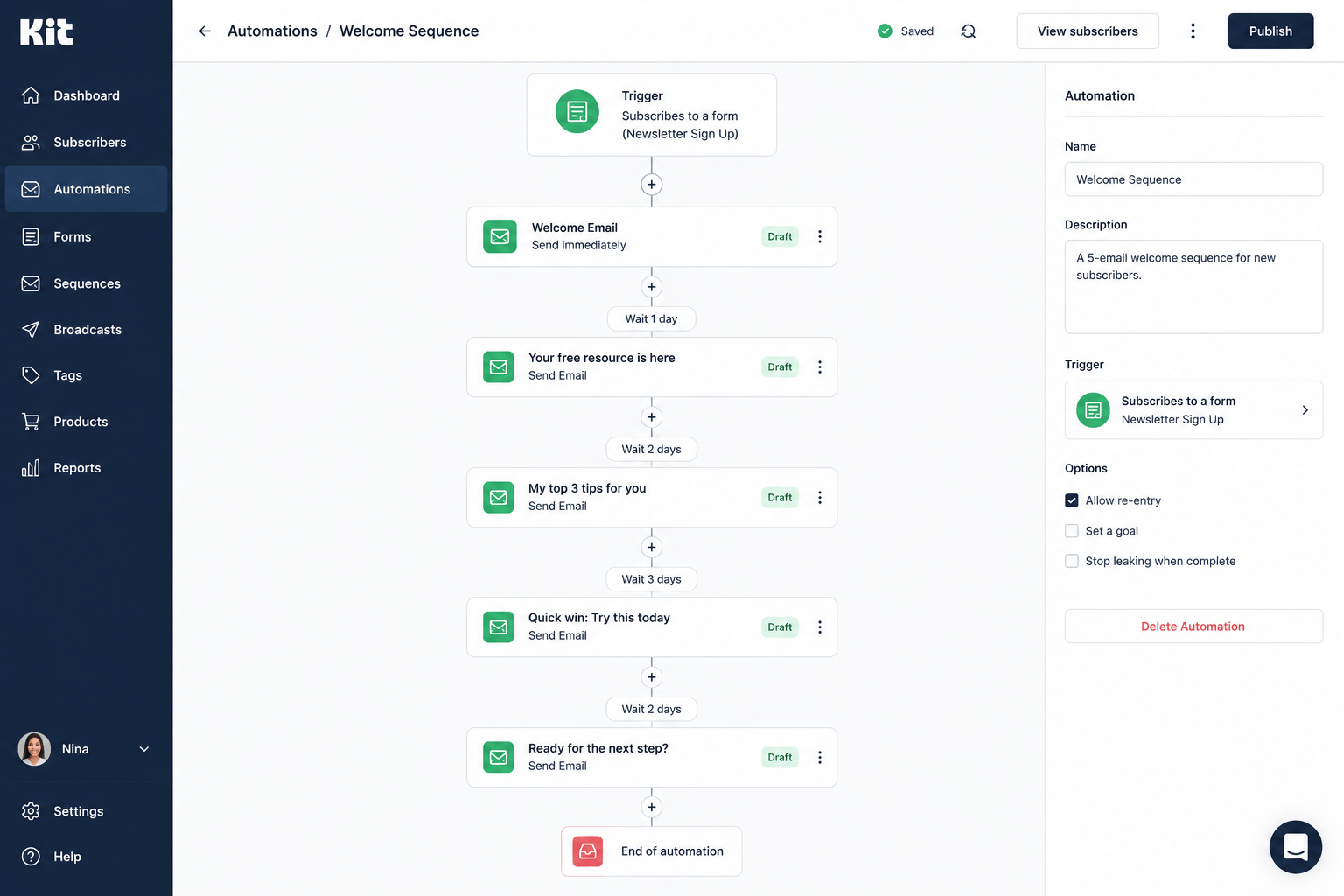
Kit’s automation builder is visual and uses tags as triggers. The free plan includes one automation, while paid plans unlock unlimited automations and pre-built templates. You can set up welcome sequences, course launches, and conditional emails without needing a developer.
I used Kit to create a five-email welcome sequence for new subscribers. The visual automation builder made it easy to map out the entire customer journey. Setting up email delays and moving subscribers through the sequence felt intuitive.
At first, I found the distinction between broadcasts, sequences, and automations a little confusing. Once I understood how the pieces connected, I was able to build and launch the automation in under an hour.
Built-in monetisation
This is where Kit stands apart. You can sell digital products, charge for paid newsletters, and earn from a sponsor network without leaving the platform. For creators planning to monetise their list, this matters a lot.
Landing pages and forms
Kit includes unlimited forms and landing pages on every plan, including the free one. The templates are clean rather than flashy. They are designed to convert subscribers, not to win design awards.
Deliverability
Kit claims a 99.8% delivery rate and publishes deliverability reports, which is more transparent than most platforms. Plain-text style emails also tend to land in the inbox more often than heavy HTML designs.
Kit pros and cons
What I liked
- Generous free plan up to 10,000 subscribers
- Tag-based system, no duplicate contact billing
- Built-in tools to sell digital products and paid newsletters
- Strong deliverability and published reports
- Free migration help from other platforms
What frustrated me
- Paid plans got 35% more expensive in September 2025
- Only one automation on the free plan
- Templates are clean but not as visual as Mailchimp’s
- Pricing scales steeply once you pass 1,000 subscribers
- Designed for creators, not a great fit for general business
Who should use Kit?
Kit is a great fit if you:
- Are a blogger, podcaster, course seller, or newsletter writer
- Want a generous free plan to start from zero
- Plan to monetise your list with digital products or paid newsletters
- Prefer tag-based subscriber management to multiple lists
Look elsewhere if you:
- Have a tight budget and a growing list (MailerLite is cheaper)
- Need beautiful, image-heavy templates (Mailchimp is stronger here)
- Want deep marketing and sales automation (ActiveCampaign goes deeper)
- Are not a creator and do not plan to sell anything to your list
Kit vs the alternatives
Kit’s price rises have made its rivals look more attractive. Here is how it stacks up against the two most relevant alternatives.
| Kit (ConvertKit) | MailerLite | Mailchimp | |
|---|---|---|---|
| Best for | Creators | Value, simplicity | Templates, beginners |
| Free plan | Yes (10,000 subscribers) | Yes (1,000 subscribers) | Yes (250 subscribers) |
| Starting paid price | $33 / month (annual) | Low, list-based | $13 / month |
| Automation | Strong, unlimited on paid | Included on free | Standard plan and up |
| Monetisation built in | Yes | Limited | Limited |
If Kit’s price rises are a problem and you do not need creator monetisation tools, MailerLite is the cleanest cheaper switch. For more polished templates, see my Mailchimp review. For deeper marketing automation, read the ActiveCampaign review.
For all three side by side, see my Mailchimp vs ConvertKit vs ActiveCampaign comparison.
Frequently asked questions
Is Kit the same as ConvertKit?
Yes. ConvertKit rebranded to Kit in October 2024. The platform, accounts, and features stayed the same. Only the name and logo changed.
Is the Kit free plan really free for 10,000 subscribers?
Yes. The Newsletter plan is free with no time limit and covers up to 10,000 subscribers. The trade-off is that you only get one automated sequence and limited integrations.
How much does Kit cost in 2026?
Creator starts at $33/month billed yearly, or $39/month month-to-month, for 1,000 subscribers. Creator Pro starts at $66/month yearly, or $79/month monthly. Prices rise as your subscriber count grows.
Is Kit good for beginners?
The free plan is one of the easiest places to start an email list. Paid plans are aimed at creators who plan to grow and monetise, so they may feel expensive if you just want simple newsletters.
What is the best Kit alternative?
It depends on what you need. MailerLite is the best value for budget-conscious creators. Mailchimp offers more polished templates for visual emails. ActiveCampaign suits anyone who needs deeper marketing and sales automation.
The bottom line
Kit is still one of the strongest email platforms for creators in 2026. The free plan up to 10,000 subscribers, the tag-based subscriber model, and the built-in commerce tools all set it apart. The September 2025 price rises do hurt its value, especially against MailerLite.
If you are a creator who plans to grow and monetise a list, Kit is well worth the money. If you mostly want a simple newsletter and watch every dollar, a cheaper alternative may suit you better.
Free plan up to 10,000 subscribers. 14-day trial of paid plans.
IT graduate and freelance web specialist who has built WordPress sites and run email campaigns for clients since 2020. Every review on SoftwareStackPro is based on hands-on testing. More about how I review →