Cheapest Web Hosting in 2026: What You Really Pay After Renewal
Disclosure: SoftwareStackPro may earn a commission if you sign up through some links on this page, at no extra cost to you. It never changes our verdicts. Read our affiliate disclosure.
The cheapest web hosting ad you see today is almost never the price you keep paying. Most hosts sell year one at a deep discount, then bill you the full rate when the plan renews.
That second bill is where budgets break. This guide shows the real cost of five popular budget hosts over three and five years, not just the first invoice.

Quick answer
Namecheap Stellar is the cheapest web hosting over five years at about $251 in total. Hostinger Premium is a close second at about $275, and it is the better pick if you can pay for 48 months upfront.
Leaning toward Namecheap? Our Namecheap hosting pricing guide breaks down every Stellar plan and the extras that raise the bill.
Key takeaways
- Renewal prices on budget shared hosting are 2 to 4 times the intro price on most plans.
- The biggest jump we found was IONOS Plus, from $1 to $14 a month. That is a 1,300% increase.
- Hostinger’s $2.99 price needs a 48 month commitment and $143.52 paid upfront.
- Namecheap has the smallest jump. Its yearly price roughly doubles, from about $27 to $55.88.
- Free domains and free email are usually free for the first year only.
Why the renewal price matters more than the intro price
A website is a long project. Most blogs and small business sites take a year or more to earn steady traffic, so you will almost certainly reach your first renewal.
Hosts know this. Themeisle’s long term pricing study found that renewal prices tend to be 2 to 4 times higher than intro prices.
The market is also huge, which keeps the discount war going. WordPress alone runs about 42% of all websites according to W3Techs, and most of those sites start on cheap shared hosting.
So the smart question is not “what is the lowest price today?” It is “what will I pay in total by year three and year five?”
Cheapest web hosting: intro price vs renewal price
Here is what each host advertises today, and what it charges when the first term ends. We used the cheapest plan that most beginners actually buy.
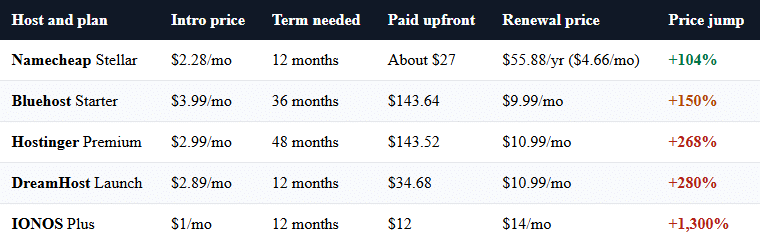
Sources: official pricing pages for Namecheap, Bluehost, Hostinger, DreamHost and IONOS, 11 October 2026. US dollar prices, before tax.
Notice the pattern. The lower the intro price, the harder the renewal hits.
What you really pay over 3 and 5 years
This is the table that matters. It adds the intro term and the renewals together, using each host’s listed renewal rate.
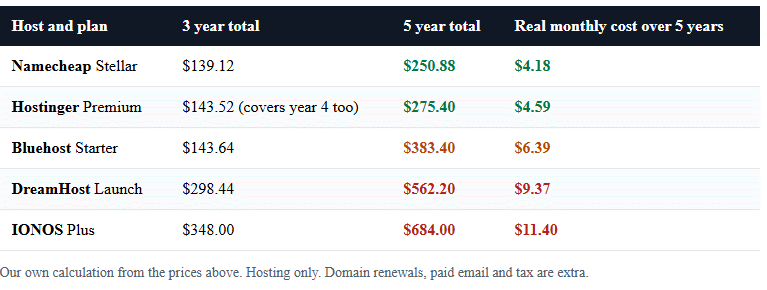
Our own calculation from the prices above. Hosting only. Domain renewals, paid email and tax are extra.
Three things stand out. First, the three cheapest hosts cost almost the same for the first three years, within $5 of each other.
Second, the gap opens after that. By year five, IONOS Plus costs 2.7 times what Namecheap does, even though it had the lowest sticker price.
Third, the “$1 a month” plan is the most expensive plan on the list. Its real monthly cost over five years is $11.40.
Host by host: the fine print
Namecheap Stellar: lowest long term cost
Namecheap charges $2.28 a month for the first year, then $55.88 a year after that. You get 3 websites, 20 GB of SSD storage and 30 mailboxes.
The first year only needs about $27 upfront, which is the lowest entry cost with a low renewal. Read our Namecheap review for speed and support details.
Hostinger Premium: best value if you commit
Hostinger’s $2.99 a month is real, but only on the 48 month plan. You pay $143.52 on day one, and the plan renews at $10.99 a month.
That upfront payment locks in four years at a price lower than one year at the renewal rate. See our Hostinger review for our test results.
Bluehost Starter: fair price, watch the term
Bluehost Starter costs $3.99 a month on a 36 month term and renews at $9.99 a month. It includes 10 websites and 10 GB of NVMe storage.
The $9.99 renewal rate applies when you renew for another 36 months. Shorter renewal terms cost more per month, so check the Renewal Center in your account before the term ends.
Our Bluehost review covers speed, uptime and renewal costs in more depth. You can also compare it directly in Bluehost vs Hostinger and Bluehost vs Namecheap.
DreamHost Launch: cheap year one, costly after
DreamHost Launch is $2.89 a month for the first year, or $34.68 in total. It then renews at $10.99 a month, which is $131.88 a year.
You do get 25 websites and daily backups. DreamHost also prints the renewal rate right on the plan card, which is more honest than most.
IONOS Plus: the $1 plan that costs the most
IONOS Plus is $1 a month for the first year, a 94% discount. After 12 months it moves to $14 a month.
It is a fine deal for a one year project. For a site you plan to keep, the smaller IONOS Essential plan at $4 then $8 a month works out cheaper over time.
What a cheap host must still include
Cheap is only useful if the site works. Here is the short list of things even the cheapest plan must have.
- Free SSL certificate. This gives you the padlock and https. Never pay extra for it.
- One-click WordPress install. WordPress runs about 42.6% of all websites, so most tutorials you find will assume you use it.
- Decent speed. Google research found that 53% of mobile visits are abandoned if a page takes longer than 3 seconds to load.
- At least 99.9% uptime. That still allows almost 9 hours of downtime a year, so do not accept less.
- A 30-day money-back guarantee. It lets you test the host with no risk.
- Support you can reach. Live chat matters most in your first month, when everything is new.
You do not need unlimited websites, a dedicated IP or 100 GB of storage. A new blog or small business site uses a tiny slice of that.
Hidden costs beyond the renewal price
The hosting renewal is the big one. These smaller charges also show up in year two.
- Domain renewal. The free domain is free for one year on every host here. After that it renews at the registrar’s regular rate.
- Email. Bluehost’s Pro Email is a free trial that then costs $2.50 a month. DreamHost includes mailboxes for three months, and Hostinger includes them for one year.
- Refund deductions. Bluehost keeps a domain fee if you cancel within 30 days and used the free domain.
- Tax. Listed prices exclude VAT, so your checkout total may be higher depending on your country.
- Checkout add-ons. Backups, security tools and SEO extras are often ticked by default. Untick what you do not need.
We break down the domain part in our guide to free domain hosting deals that are actually worth it.
How to lower your hosting renewal bill
- Buy the longest intro term you can afford. The discount applies to the whole first term, so 48 months at $2.99 beats 12 months at $2.99.
- Put the renewal date in your calendar. Set a reminder 30 days before, so the charge never surprises you.
- Turn off auto renew early. This forces you to make a choice instead of paying the default rate.
- Ask support for a renewal discount. Many hosts will offer one if you ask in live chat before the term ends.
- Be ready to move. Hostinger, Bluehost, Namecheap and DreamHost all offer free migration, so switching to a new intro deal is realistic.
- Keep your domain separate. A domain held at a different registrar makes it much easier to change hosts.
- Test speed in week one. Run your site through Google PageSpeed Insights. If it is slow, use the 30-day money-back guarantee while you still can.
A caution on host hopping
Moving every year to chase intro prices works, but it costs time and carries some risk. For a site that earns money, a stable host at a fair renewal rate is usually worth a few extra dollars.
Which cheap host should you pick?
- Smallest upfront payment: Namecheap Stellar, at about $27 for year one.
- Lowest cost over 4 years: Hostinger Premium, if you can pay $143.52 today.
- Guided WordPress setup: Bluehost Starter, with a mid range renewal.
- A one year test project: IONOS Plus at $12, as long as you cancel or switch before month 13.
- Backups included from day one: DreamHost Launch.
Still unsure? Answer three quick questions.
- How long will you keep the site? For a long-term project, pick on the 5-year cost. Namecheap or Hostinger will save you hundreds.
- Can you pay upfront? Hostinger’s best price needs a 4-year payment. If that is too much at once, Namecheap’s 1-year plan is the easier start.
- How many sites will you run? Bluehost’s entry plan allows one website. Hostinger and IONOS let you add more without upgrading.
New to all this? Follow our guide on how to start a WordPress blog.
Readers in East Africa should also see our picks for the best web hosting for WordPress beginners in Kenya and Africa.
Related: Deciding between two budget hosts? Read Hostinger vs Namecheap, with a total cost calculator.
Related: Black Friday 2026 software deals tracker for email and hosting
Frequently asked questions
What is the cheapest web hosting in 2026 after renewal?
Namecheap Stellar is the cheapest of the five hosts we compared. It costs about $251 over five years, or $4.18 a month on average.
Why do web hosting prices go up after the first term?
The first term is a promotional price used to win new customers. When it ends, the plan renews at the host’s regular rate, which is usually 2 to 4 times higher.
How much does Hostinger cost after renewal?
Hostinger Premium renews at $10.99 a month after the intro term. The $2.99 intro price requires a 48 month plan paid upfront.
How much does Bluehost cost after renewal?
Bluehost Starter renews at $9.99 a month when you renew for 36 months. Shorter renewal terms cost more per month.
Can I avoid paying the renewal price?
Yes. You can buy a longer first term, ask support for a renewal discount, or migrate to another host before the term ends.
Is the cheapest web hosting good enough for a real website?
For a new blog or small business site, yes. Shared plans from these hosts handle early traffic well, and you can upgrade when the site grows.
Is $1 a month hosting any good?
It can be fine for a small first site. The risk is the renewal price, which can be 10 times higher, so check it before you sign up.
Is free web hosting worth it?
Not for a site you care about. Free hosts usually add ads, limit speed and do not let you use your own domain properly.
Do I need to pay for 4 years upfront?
No. Namecheap, DreamHost and IONOS all offer low prices on a 12-month term, though the longest terms give the lowest monthly rate.
Final verdict
The cheapest web hosting in 2026 is the plan with the lowest total cost, not the lowest sticker price. On that measure Namecheap wins over five years and Hostinger wins if you prepay for four.
Whichever host you choose, write down the renewal price and the renewal date before you pay. Still comparing? Our best website hosting guide and the full web hosting category cover

By Vincencia Anyango · Editor & Lead Reviewer
Last updated: October 2026 · 9 min read
IT graduate and freelance web specialist who has built WordPress sites and run email campaigns for clients since 2020. Every review on SoftwareStackPro checks pricing and plan limits against the vendor’s own pages. More about how I review →
Related reading
>>>Worst Web Hosting? 10 Red Flags to Check Before You Pay
>>>Bluehost Review 2026: Real Speed, Uptime and Renewal Costs
>>>Free Domain Hosting Deals That Are Actually Worth It
>>>Best Web Hosting for WordPress Beginners in Kenya and Africa (2026)