AI Tools That Actually Improve Email Marketing Results
I have spent the last year running the same list through four different platforms. Some AI features saved me real hours. Others produced copy I deleted within thirty seconds.
This post separates the two. You will get the data, the four jobs AI genuinely does well, and which platform handles each one best.
The short version. AI lifts email revenue when it is pointed at segmentation, timing and testing. Pointed at copy alone, the lift is marginal.
Programs running AI across four functions at once saw revenue lifts near 41%. Programs using only one or two features saw 8% to 14%.
What is in this post
- What the 2026 data says
- Four jobs AI does well
- What AI still gets wrong
- The four platforms compared
- Choosing by list size
- A 30 day plan
- AI is reading your email too
- Questions
What the 2026 data actually says about AI in email
AI adoption in email is now close to universal. In the Litmus State of Email 2026 report, only 5% of marketers said they were not using AI for email marketing at all, while 28% described AI as deeply integrated into their workflows and decision making.
The interesting part is the gap between those two groups. Litmus, now part of Validity, surveyed over 500 marketing professionals across the US, UK, Australia and New Zealand, and found that advanced AI adopters are 75% more likely to achieve email ROI above 45:1.
That is not a rounding error. The channel average sits around $36 to $42 back for every $1 spent, so a 45:1 program is running a fundamentally better business on the same infrastructure.
Speed changed too. In 2024, 62% of teams needed two weeks or more to ship a single email. By 2026, 76% deploy within three days.
Where the revenue actually sits
Here is the stat that should shape your whole strategy. Klaviyo’s benchmark data shows that automated flows generate nearly 41% of total email revenue from just 5.3% of sends, with revenue per recipient roughly 18 times higher than one-off campaigns.
Those same flows deliver over 3 times the click rate of campaigns, 5.58% against 1.69%, and 13 times the placed order rate.
Read that again. The money is in automation and timing, not in writing prettier newsletters.
So the AI features worth paying for are the ones that improve automation and targeting. The ones that just generate more copy are solving a problem you do not have.
One more caveat. Litmus data from late 2025 showed Apple Mail accounting for 60.6% of all tracked email opens, which means Apple’s privacy protection is inflating your open rate.
Judge every AI feature on clicks, conversions and revenue per recipient. Open rate is now a directional signal at best.
The four jobs AI actually does well in email
After testing across four platforms, the useful features cluster into four buckets.
First drafts and subject line variants
AI is a good ghostwriter and a terrible finisher. It gets you from blank page to rough draft in about ninety seconds.
Where it earns its keep is volume testing. Generating fifteen subject line variants by hand takes twenty minutes, and most marketers stop at two.
The catch is voice. Every draft I have used needed a full rewrite pass before it sounded like a human wrote it.
Segmentation you would never build by hand
This is the most underrated feature in the category. Predictive segmentation scores your subscribers on likelihood to buy, likelihood to churn, and expected lifetime value.
You then build flows around those scores. That is how you get from a broadcast list to something closer to those 41% flow numbers.
Manual segmentation caps out at whatever rules you can imagine. Predictive segmentation finds patterns in behaviour you never thought to query.
Send time optimisation
Every subscriber has a window where they actually open email. AI send time optimisation learns that window per person rather than per list.
The lift is modest on its own. It compounds when you stack it with better segmentation, which is exactly the pattern in the research.
Salesforce data cited alongside the 2026 benchmarks suggests programs running AI across all four core functions, meaning segmentation, content personalisation, subject line optimisation and send time optimisation, saw revenue lifts averaging 41%. Programs using only one or two AI features saw much smaller gains of 8% to 14%.
That is the single most important finding in this post. Half-implemented AI barely moves the needle.
Pre-send checks
This is the least glamorous and most reliable use. AI-assisted checks catch broken links, spam trigger language, dark mode rendering failures and accessibility problems before you hit send.
Litmus found advanced AI adopters were 54% more likely to follow WCAG accessibility standards and 52% more likely to comply with the European Accessibility Act.
Accessible email is not just compliance. It is more readable email, which means more clicks.
What AI still gets wrong
I would be doing you a disservice if I only listed the wins.
- It invents facts. Every AI draft mentioning a price, a date or a statistic needs checking against the source. I have caught fabricated numbers in almost every tool I tested.
- It flattens your voice. AI copy reads competent and forgettable. If your list subscribed because they like how you write, generated copy will quietly erode that.
- It cannot fix a bad list. No amount of AI rescues a list built from a purchased CSV. Deliverability problems are data problems, not copy problems.
- It does not set strategy. AI will happily optimise a campaign that should never have been sent. What to send and to whom is still your call.
AI features across the four platforms I have tested
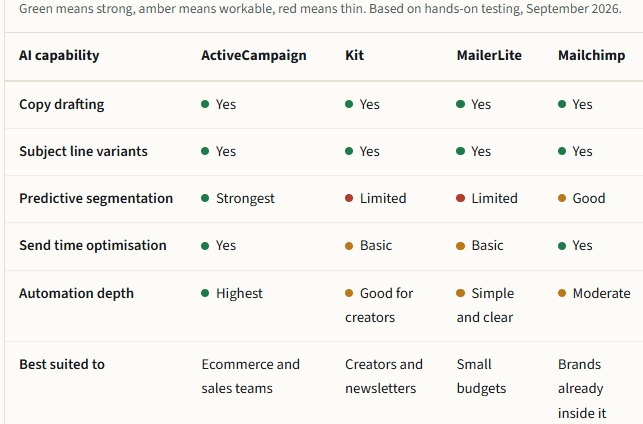
Here is how AI capability actually breaks down between the four email platforms reviewed on this site.
| AI capability | ActiveCampaign | Kit | MailerLite | Mailchimp |
|---|---|---|---|---|
| Copy drafting | Yes | Yes | Yes | Yes |
| Subject line variants | Yes | Yes | Yes | Yes |
| Predictive segmentation | Strongest | Limited | Limited | Good |
| Send time optimisation | Yes | Basic | Basic | Yes |
| Automation depth | Highest | Good for creators | Simple and clear | Moderate |
| Best suited to | Ecommerce and sales teams | Creators and newsletters | Small budgets | Brands already inside it |
ActiveCampaign: the strongest AI segmentation
If you want predictive scoring and genuinely complex conditional automation, this is the one. The learning curve is steep and the interface is dense.
It is overkill for a 500-person newsletter. It is the right call if you are running ecommerce flows with real revenue attached.
Read the full breakdown in the ActiveCampaign review.
Kit: AI that respects a creator’s voice
Kit’s AI features are deliberately restrained. The drafting tools are there, but the platform is built around sequences and tagging rather than predictive modelling.
For newsletter writers that restraint is a feature. Your subscribers came for your voice, and Kit does not push you to automate it away.
Full details in the Kit and ConvertKit review.
MailerLite: the best AI value at entry level
MailerLite gives you AI drafting and clean automation at a price the others do not match. The predictive features are thinner.
Worth noting that MailerLite restructured its plans in June 2026, so check current pricing before committing. The MailerLite review covers the updated tiers.
Mailchimp: solid AI, awkward pricing at scale
Mailchimp’s AI tooling is mature and its content assistant is genuinely useful. The problem is what happens to your bill as the list grows.
If you are already embedded in the ecosystem it holds up. If you are starting fresh, run the numbers first using the Mailchimp review.
How to choose based on your list size
- Under 1,000 subscribers. Do not pay for AI segmentation yet. You do not have enough behavioural data for predictions to mean anything, so pick the cheapest tool with clean automation.
- 1,000 to 10,000 subscribers. Send time optimisation and basic predictive scoring start paying off here. You finally have enough signal for the models to learn from.
- Over 10,000 subscribers. Predictive segmentation becomes the highest-value feature available to you. This is where the 41% revenue lift lives.
Compare the full set of options across the email marketing software reviews.
A 30 day plan to put AI to work
Do not switch everything on at once. Work through this in order.
Week 1
Audit your existing automated flows. If you only have a welcome email, build an abandoned browse or re-engagement flow before touching any AI feature.
Week 2
Turn on send time optimisation and leave it alone. It needs a few sends to learn.
Week 3
Use AI to generate ten subject line variants per campaign and A/B test the top two. Track click-through rate rather than opens.
Week 4
Switch on predictive segmentation if your platform offers it. Build one flow for your highest-scoring subscribers and one for churn risk.
Measure at day 30 against revenue per recipient. That number does not lie the way open rates do.
AI is also reading your emails now
Here is the shift most marketers have missed. AI now sits on the receiving end of your campaigns too.
Gmail and Apple Mail both summarise and prioritise messages before the subscriber sees them. Your subject line is no longer the only thing competing for attention.
The Litmus 2026 report makes the point directly. Most teams are using AI to send more, while fewer are thinking about what happens when AI decides what gets read.
The practical response is clear writing. Front-load the value in your first sentence, because that is what gets summarised.
Frequently asked questions
Do AI email marketing tools actually increase revenue?
Yes, but only when applied across multiple functions. Programs using AI for segmentation, personalisation, subject lines and send timing together saw the largest lifts, while one or two features produced single-digit gains.Should I let AI write my entire email?
No. Use it for first drafts and subject line variants, then rewrite in your own voice and fact-check every number.Which platform has the best AI for a small list?
MailerLite offers the best AI value at entry level. Predictive features matter far less below 1,000 subscribers.Will AI-written emails hurt deliverability?
Not directly. Generic, low-engagement content hurts deliverability, and AI makes generic content easier to produce at volume.Is open rate still a useful metric in 2026?
Only as a directional signal. With Apple Mail accounting for the majority of tracked opens, click-through rate and revenue per recipient are far more reliable.
The bottom line
AI email marketing tools are not a shortcut to a better list. They are an amplifier.
Point them at automation, segmentation and timing and the data says you will see real returns. Point them at churning out more newsletters and you will get more newsletters nobody opens.
Start with your flows. Then pick the platform that matches your list size, not the one with the longest AI feature list.
Sources: Litmus State of Email 2026 and Klaviyo Email Marketing Benchmarks.
SoftwareStackPro tests every tool it reviews. Nothing is recommended that we would not run ourselves.